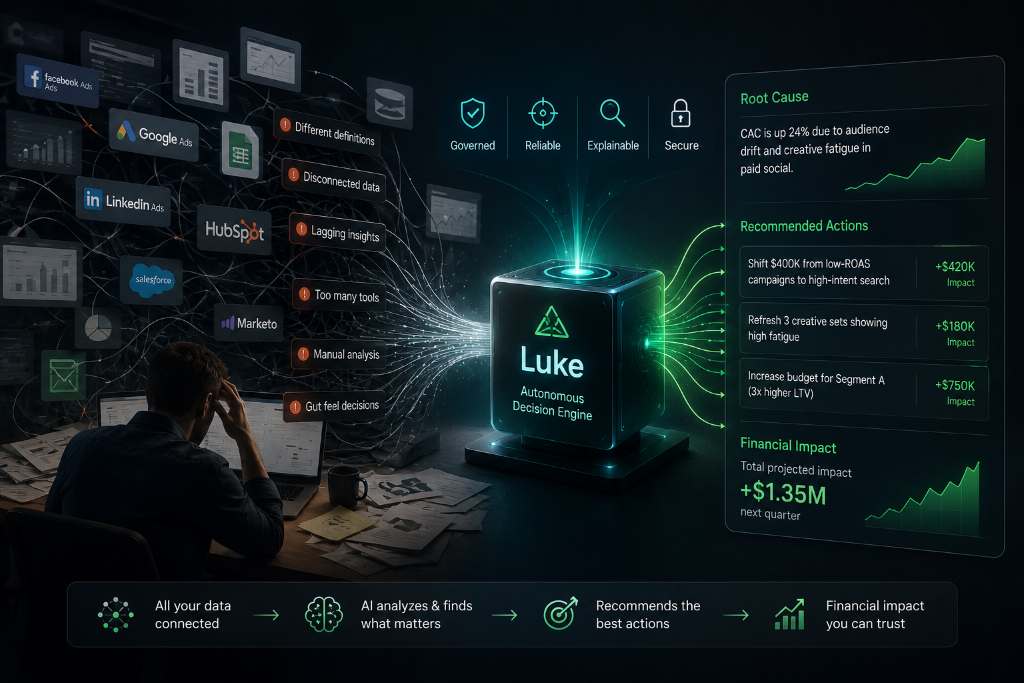
The dashboard was green. The growth was dying.
That's the line a CMO told me last week. Every weekly KPI was hitting. Lead volume up. CPL down. Pipeline coverage looked clean. Then the board meeting came and the same numbers told a different story. Net-new ARR was sliding. Expansion was flat. CAC payback had stretched past 18 months and nobody could explain why.
I've had versions of this conversation with 20+ senior marketing and growth leaders over the last 6 months. The companies are different. The pattern is the same.
McKinsey interviewed 50+ senior marketing leaders. None could clearly articulate their martech ROI. B2B SaaS now generates roughly $3 of revenue per dollar of sales and marketing spend, half what it produced in 2024. CAC payback stretched to 12-24 months. 77% of CMOs are now under pressure to prove short-term ROI.
41% of marketers can prove the ROI of their AI tools in 2026. Last year it was 50%. The bar is rising faster than the measurement infrastructure.
So what's actually broken?
Marketing teams have more data than ever and less ability to make decisions with it. The enterprise stack runs 8 to 25 tools, each with its own definition of a lead, a customer, a conversion. Dashboards focus on what's easy to measure: cost per lead, click-through rate, MQL volume, impression share. Revenue lives downstream, in CRM and finance, weeks or months later.
So campaigns scale on cost-per-lead before anyone sees whether those leads convert. Budget shifts happen quarterly, by gut feel, not in response to revenue signal. By the time the green dashboard turns red, the quarter is over.
The same line shows up in practitioner threads every week. We know what happened. We're guessing at why.
The same four questions come up every time:
Why is CAC going up?
Which budgets should I move today to protect revenue next month?
Is performance dropping because of creative fatigue, audience drift, or funnel leakage?
Which leads will convert into real revenue, not just clicks?
Here's what's shifting underneath all of this.
The lead-volume era is ending. Pavilion's data shows existing customers generate 40% of net-new ARR for SaaS, and over 50% for companies above $50M ARR. The wrong customer at scale damages long-term ARR. Accounts that won't expand or renew sit in the base, and the cost compounds quarter after quarter. A $1,000-CAC customer who churns in 9 months damages your next 24 months of revenue. None of that shows on a cost-per-lead dashboard.
The metric that matters now is revenue quality. Which channels recover their cost? Which segments are worth 3x more over 24 months? Which campaigns generate accounts that expand vs accounts that churn?
That's a different question, and most existing infrastructure can't answer it. Attribution models argue over which channel deserves the credit for a conversion. Dashboards report what changed. Neither tells you what to do tomorrow morning, in dollars.
This is why we're building Luke. An autonomous decision engine for marketing and growth. Connecting marketing actions to financial outcomes a CFO recognizes. A decision layer that says: this channel is shortening your CAC payback. This segment expands at 3x your average. This budget shift recovers $400K next quarter. Every recommendation comes with the drivers, the tradeoff, and the dollar impact.
The CFOs I talk to all ask the same question. Where is the budget going, and what's the financial impact?
Three years ago a green dashboard got CMOs promoted. In 2026 it's what CFOs point at when the budget gets cut.
The teams building the connective tissue between campaign action and closed-won revenue are the ones still standing when the next round of cuts comes.
References
B2B SaaS S&M efficiency, CAC payback, and Pavilion expansion-revenue data – AZ Big Media, Why B2B SaaS Companies Are Losing the Paid Acquisition Game in 2026: https://azbigmedia.com/business/why-b2b-saas-companies-are-losing-the-paid-acquisition-game-in-2026/
AI ROI accountability (41% / 50% data) – G2 Spring 2026, AI in B2B Marketing: https://learn.g2.com/ai-in-b2b-marketing
Marketing stack fragmentation – Reddit r/analytics customer-stack audit: https://www.reddit.com/r/analytics/comments/1sbz6xh/am_i_losing_my_mind_i_just_audited_a_customers/
McKinsey martech ROI research (50+ in-depth interviews, 200+ leader survey) – McKinsey, Rewiring martech: From cost center to growth engine: https://www.mckinsey.com/capabilities/growth-marketing-and-sales/our-insights/rewiring-martech-from-cost-center-to-growth-engine
77% of CMOs under short-term ROI pressure (LinkedIn survey of 494 CMOs) – Marketing Week, Majority of CMOs under pressure to prove short-term ROI: https://www.marketingweek.com/cmos-pressure-prove-short-term-roi/
Averi.ai, The 2026 Marketing Budget Reality Check: https://www.averi.ai/blog/the-2026-marketing-budget-reality-check-how-to-justify-every-dollar-in-the-age-of-ai
Funnel.io, The ROI reckoning and why CMOs need marketing intelligence in 2026: https://funnel.io/blog/roi-of-marketing
Campaign US, CMO Outlook 2026: Marketing spend is up, but confidence is down: https://www.campaignlive.com/article/cmo-outlook-2026-marketing-spend-up-confidence-down/1942589